Prithu Sanyal

Category: Writings

All Writings will be posted under this category.

  • A Demon’s Testimony

    A Demon’s Testimony

    Autobiography · The Village

    Humayun Azad once said that no Bengali has ever written an autobiography, because writing one requires honesty; the Bengali autobiography is really the autobiography of an angel, written by the devil. I want to walk the opposite road. I want to write my own story honestly — and if the angel’s mask slips in the process, if I turn out to be the devil, or something lower than the devil, a pishach, a demon — then so be it. What follows is that demon’s testimony.

    A Village Without Electricity

    I was born on the first of December, 1985, and the first ten years of my childhood were spent in a village so remote that evening arrived there as a joint production of kerosene lamps and fireflies. As far as I know, the electric line has still not reached it; at most, solar panels bask on the roofs of two or four houses. A forgotten settlement, lying neglected in a corner of the map.

    I say “as far as I know” because I have no way of knowing for certain — I no longer have any contact with anyone from the village. When and why the cord that once tied me to that soil was severed is a story to be kept for another day.

    The village is called Bosontopur; rubbed smooth in people’s mouths, the way a stone is rounded by a river’s current, the name has worn down to Bosonpur. Twice a week, on Fridays and Mondays, the market was held at Bosonpur Bazar. People came from several villages around. On market days the whole bazar seemed to wake from sleep and shake itself; for the other five days it dozed, waiting for the next market.

    A road leads out from the northern end of the bazar. Walk about three hundred metres along it from the last shops and you reach Bosontopur Primary School. Past the school stands the house of the headmaster, Sujat Ali — my khalu, the husband of my mother’s half-sister. Then comes the Karims’ house, and right after that, ours. That road was the spine of my childhood — the noise of the bazar at one end, school and kinship in the middle, home at the other. The first map of my life was drawn on that one short stretch of road.

    I don’t remember exactly in which year our tin-roofed house went up. I do remember the house before it — a thatched roof of straw overhead, walls of ikor all around. Ikor is a tall grass, rather like reed. One day the tin came and pushed the straw aside, the way time pushes everything aside — without much announcement.

    We were two brothers and two sisters. My father was Matin Master. My mother had a proper name — Rahela Khatun — but almost no one called her by it; to everyone she was Masum’s mother. This is how the names of village women vanish — behind the names of their children, as if motherhood were their only identity card. That was our household.

    Gula

    Of all the childhood memories still settled at the bottom of my mind, the oldest is probably the flood of 1988. I was a little over two and a half. The memory is not clear; it is blurred, like a picture behind frosted glass. Faintly I recall the water spilling over the embankment beside our house and climbing into the courtyard, touching the threshold of our room, like an uninvited guest waiting for permission to come in. Snakes were playing in the courtyard, and the whole house was swarming with ants — every creature that had lost its dry ground had found shelter in the house of humans.

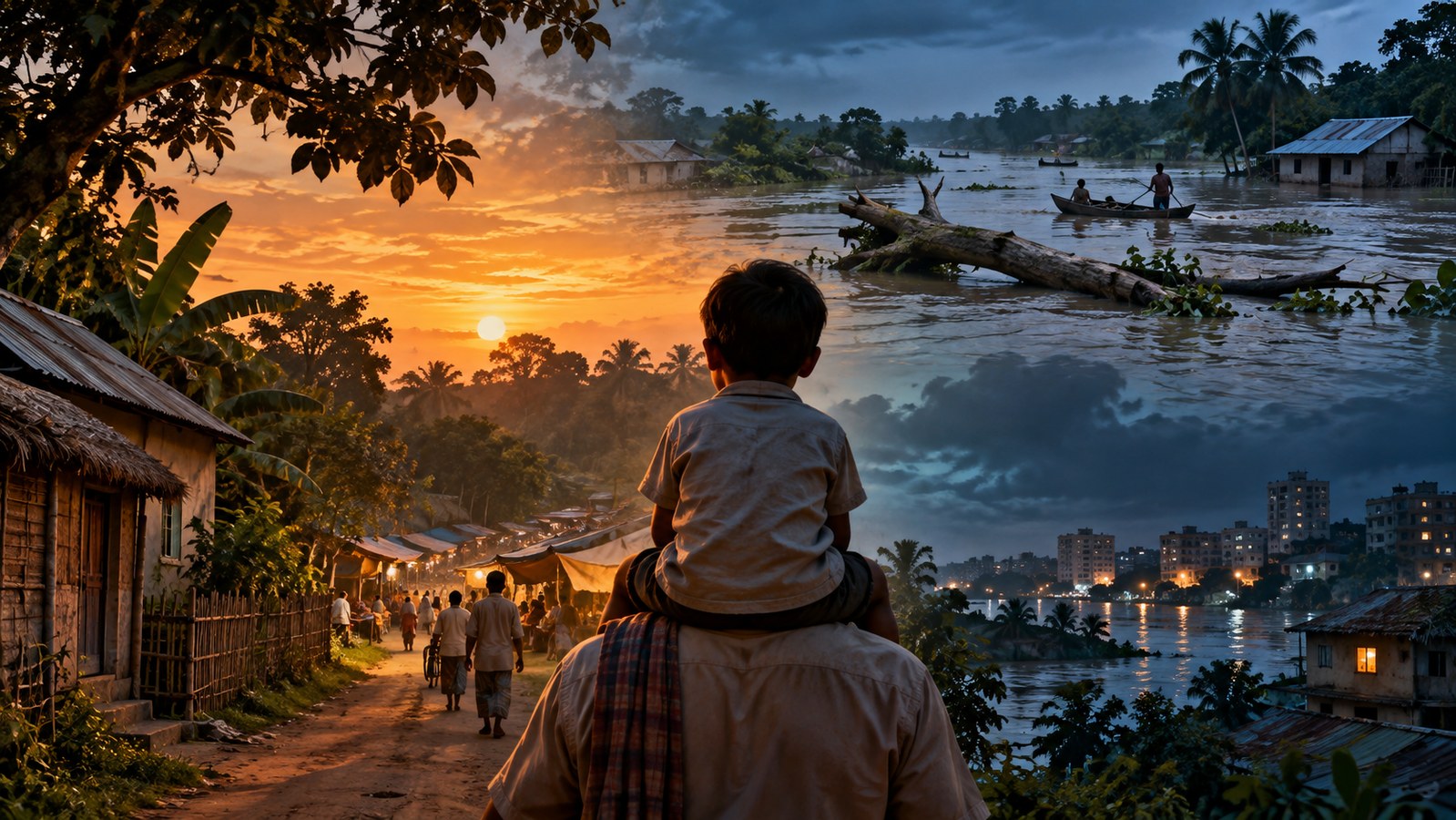
    And yet floods were no strangers to us. They came every year; we called them “gula.” For a single day the village fields went under — the water came in the morning and went back in the afternoon, or the next day at the latest. People would say, “Gula aise” — the gula has come. A gula never stayed more than three days. A once-a-year guest — a little commotion, a little mud, and then goodbye.

    If anything, the day of the gula was like a festival. People went out in their boats to catch the big trees that the hill torrents carried down. There was firewood, of course, but also timber good enough for furniture. Much of the furniture in our village home was made from those trees that floated in on the gula. What the hills lost became, in our house, something to sit on, sleep on, keep things in. One place’s ruin is another place’s household — I didn’t understand that lesson then, but I had already learned it.

    So I had no idea that a flood could last, that it could ruin people’s lives — not until I left the village in 1998. I was twelve then, nearly thirteen; it was my first year after leaving the village for good and moving to the town. That same year I faced, for the first time, a flood that would not go back. For days on end people were trapped by water. The water that had been festival and gift in my childhood appeared in the town as a prison. The same water, a different face — perhaps that was the first lesson the town ever taught me.

    Strangers’ Shoulders

    The next memory that comes back is of a small boy standing alone on the road beside his house. Whenever he saw someone heading towards the bazar, he would block their way and say, “Carry me on your shoulders, take me to the bazar.” My father had a homeopathy shop in the bazar. Strangers would lift me onto their shoulders and set me down in front of my father’s shop.

    Thinking of it now, I am amazed — with what fearless trust a child handed himself over to strangers’ shoulders, and how effortlessly those strangers delivered him to exactly the right place. In truth, there were no strangers in that village; there were only familiar people whose names one did not know. Strangers’ shoulders were my first vehicle in life, and the swaying world seen from up there — over the heads of the crowd, a little removed from everything — perhaps that was my first lesson in becoming an observer.

    The Book Cupboard

    My father taught at the primary school, and mornings and evenings he sat in that shop in the bazar, practising homeopathy. We siblings grew up on his treatment. We came close to death, and still not a single allopathic medicine ever passed our lips. None of us siblings was ever vaccinated — or rather, none of us was allowed to be. My father believed vaccines were a weapon of the Jews and Christians; that through them people’s antibodies were destroyed, and that vaccines were the main cause of all kinds of cancer and diabetes. The tiny white pills inside those little bottles were our only wall of protection — and the bricks of that wall were laid with faith.

    “Came close to death” is no exaggeration. My elder brother Masum, five years older than me, once fell ill with typhoid. I did not see it with my own eyes; I heard it from my mother, so everything I write of this scene has passed through the sieve of her memory. The fever will not break; the body seems to be burning from within, and my father’s little white pills melt silently in that fire. The town hospital was far away — but farther still, from my father’s faith, was a single allopathic tablet.

    In the end my brother was taken to a well-known homeopathic doctor at Shoktiar Khola Bazar. I no longer remember his name — probably Sushil Chattopadhyay, or some such name. All that survives in memory is this: he was a Brahmin, and he wore the sacred thread. The name is lost; only a single white thread remains. Two drops of the medicine he gave, and my brother recovered.

    Thinking about it today, the accounts simply do not balance. The man who believed vaccines were a weapon of the Jews and Christians handed his eldest son’s life to a Brahmin wearing the sacred thread — and the two drops that fell from that hand brought the boy back. So the wall of my father’s faith was not built with bricks of religion; it was built with bricks of doctrine. Whose hand gave the medicine did not trouble him; what troubled him was which system the medicine belonged to. And perhaps my brother’s recovery settled into that wall as one more brick — as if one life saved were proof enough, and the lives that might have been lost never entered the ledger at all.

    Still, this is no reason to think my father ignorant. Quite the opposite — he read a great deal. When he rested at home, I would see him lying on his side in bed, reading. In our room stood a steel almirah, and inside it were books and more books. That people keep clothes in an almirah was something we simply did not know until a certain age. We knew that an almirah was a house for books; clothes lived on the clothes-rack. That almirah was exactly like my father’s mind — a hard shell of steel outside, packed with letters inside, and most of those letters facing in one direction.

    You could say my pull towards books was born from watching him. Most of his books were Islamic literature, yet he considered science enormously important. He used to say —

    — There is no conflict between Islam and science; on the contrary, Islam urges science forward. Muslims are neglected all over the world today precisely because they have turned their backs on science. Muslims must take hold of science once again. Only then is the liberation of Muslims possible.

    It was out of this belief that he sent none of us siblings to a madrasa. In his view, the madrasa taught neither true Islam nor, certainly, science. And now Muslims had to learn science — so we went to school.

    His hopes for me touched the sky. As a child I was very bright — anything I read once was fixed in my head; I never had to memorise it separately. My father dreamed that one day I would become a great scientist — a Muslim scientist.

    The Inheritance of Names

    My father’s dream was written not only into our future but into our names. His political loyalty belonged to the Jamaat-e-Islami, and he named his two sons after his own leaders. My elder brother, A.K.M. Kamaruzzaman Masum — after the Jamaat leader Muhammad Kamaruzzaman. And I, A.B.M. Ashrafuzzaman — after Ashrafuz Zaman Khan, a leader of the Al-Badr in 1971. On the day we were born, we were dressed in two garments that were not cut to our measure, but to the measure of two other men.

    Ashrafuz Zaman Khan — whose men, in December 1971, took Dhaka’s intellectuals from their homes, and never allowed them to return. In 2013 the International Crimes Tribunal sentenced him to death in absentia for the killing of intellectuals.

    But that loyalty was not mere support from a distance. I have heard from my paternal aunt that in 1971 my father was a man of Trishal thana in Mymensingh, a student at some madrasa, and a member of the Islami Chhatra Sangha — the Jamaat’s student organisation, whose cadres formed the core of the Al-Badr force in 1971. In 1972 a warrant was issued in his name. I have heard that the freedom fighters of the time announced a reward of twelve thousand taka for anyone who could hand him over, dead or alive. The price of a man, dead or alive: twelve thousand taka. To save his life, my father fled Trishal for the other end of the country — Sunamganj.

    What exactly he did in 1971, I do not know. So far I have not found his name in any court verdict or any government list. What there is amounts to a few sentences from my aunt’s mouth, one warrant and one price of twelve thousand taka. Yet this much I know: the name he gave me was not the name of some distant hero; it was the name of a leader from his own organisation, from his own time. He wrapped a memento of the past he had left behind in Trishal around my body.

    In Sunamganj that fugitive young man became Matin Master — primary school teacher, homeopathic healer, owner of an almirah full of books. Beneath the soil of the village of Bosontopur, with which I began this account, another settlement lies buried, then — Trishal. The man who had himself studied at a madrasa used to say that the madrasa did not teach true Islam, and sent his sons to school. On this one point I still agree with my father today. Perhaps it was through the Jamaat that he came to see how weak madrasa Islam was in the face of modern society — openly militant, unable to keep pace with the times. The Jamaat’s Islam wanted to walk another road: to move in step with modernity — schools, science, organisation, the language of reason. My father’s dream of a “Muslim scientist” was a domestic map of that very road.

    The son whom my father named after the killer of intellectuals grew up to take up the pen, write poetry, question religion on his blog — becoming exactly the kind of man whose names were drawn up on lists in 1971. In 2015, when Niloy was hacked to death and I had to leave the country, the machetes came from new hands of that same old ideology. In 1972 my father fled to save his life, because the freedom fighters were looking for him; forty-three years later his son fled to save his life, because the heirs of his father’s ideology were looking for him. The same flight, only in the opposite direction. That same year Kamaruzzaman was hanged — the man whose name my elder brother bears. It was as if history wanted to settle the accounts of two names from one family in a single year, from two opposite sides.

    One day I shed that name like a husk — and became Prithu, and Sanyal. That story belongs to another chapter. Here I will say only this: the first testimony of my life was not given by me; it was given in my name, on my behalf, on the day I was born.

    In his dream there were two words, side by side, holding hands — “Muslim” and “scientist.” It was he himself who set me on the road of science. He just did not know where that road ends — or whether it ends at all. That the second word would one day break the first was written on no page of my father’s book-filled almirah.

    (to be continued)

  • The Inquisitive Boy’s Expeditions

    The Inquisitive Boy’s Expeditions

    Beneath a child’s feet, the earth seems to speak — every grain of dust whispers, don’t stop here. The threshold of the house becomes a border line, beyond which the whole world feels incomplete if left uncrossed. I heard that whisper long ago, perhaps even before I had language for it, and all my life that call has pulled me out through doors — sometimes in mere curiosity, sometimes in the reckless courage of love, sometimes in the terrible silence of tearing up certificates in anger. But every later escape carried within it the shadow of the very first one — the five- or six-year-old boy who walked out silently, wanting only to see a village.

    As if a road, with no beginning anywhere,
    as if a call, whose source no one knows —
    only the feet know they must walk,
    where the world begins the moment the yard ends.

    Jolilpur: The First Expedition

    The market-day gossip at Bosontopur bazaar was the only news agency our small world had. It was there, one day, that a name reached my ears — Jolilpur — wrapped in a whispered mystery: in that village, right beside the school, lived a teacher whom people carefully called an atheist. The word’s meaning was unknown to me then, but perhaps it is the unknown word that pulls hardest. To a boy of five or six, this scrap of rumor was enough to become a call to discover an entire continent.

    Telling the household would mean no one taking me, or worse, being stopped — even a child’s logic grasped that much. So, without telling a soul, I set out along the road that ran past our house from Bashantapur bazaar. In some quiet moment of the afternoon, I crossed a small field and arrived in Jolilpur.

    The village seemed like the mirror opposite of my own. In Bosontopur, the road ran past the village while the houses kept their distance, spread out in an open arrangement. In Jolilpur it was reversed — houses stood shoulder to shoulder with the road, and the trees overhead wove their shade into a green tunnel, as if the village had hidden itself from unfamiliar eyes. Walking through that tunnel, I kept thinking, surely the school lies just past this next bend — but each bend gave way only to more shade, more secluded path.

    At last, past one more hamlet, a sliver of field opened up, and beyond it, hugging the village’s edge, stood the school — a lone building curled in on itself like a shy touch-me-not plant. To eyes used to Bosontopur’s two-building school, this single building seemed almost too modest, too ordinary. I did not yet know that most primary schools in Bangladesh stood exactly like this, unapologetically, on a single structure.

    I never met that atheist teacher, never exchanged a word with him. The mystery remained a mystery that day — and now I think, perhaps that was for the best. Some curiosities survive only by staying unanswered; the moment they’re answered, they die on the spot. Past the school, I walked a little further along the footpaths between the paddies and turned back toward home before dusk fell — because even a child’s mind understood clearly enough what danger waited past sundown.

    As if mystery were a closed door,
    whose light goes out the moment it opens —
    so the boy turns back from just outside it,
    leaving the mystery intact, leaving himself unsatisfied.

    This was my first memory — the first expedition to see a distant village without telling home. A small pilgrimage on foot, yet within it slept the first breath of a lifelong tendency.

    Shoktiyar Khola Bazar: In the Guise of a Procession

    In our house at the time worked a teenage boy named Abdul Mannan. Father had seen a spark of promise in him, and so, alongside his work, arranged for him to attend school as well. This generosity bound Mannan and his family to father in a kind of blind devotion, and the two households fell into regular visiting. Beneath this relationship, though, ran another current — father was then deep in Jamaat’s organizational expansion, weaving a web of relationships everywhere in his drive to grow the membership, and it was Mannan’s promise that first drew father’s targeted attention. In that aim, father eventually succeeded — Mannan is a Jamaat man today, holding a senior position at Islami Bank Bangladesh. His fuller story can wait for another chapter.

    One day, visiting the Mannans’ house, I caught sight of a blood-red building across a horizon-wide field, as if someone had let fall a single drop of blood into all that green. Asking around, I learned it was the family planning office and rural health center, and that the place was called Shoktiyar Khola Bazar. I kept that curiosity about the red building nursed inside me, waiting for a chance — because curiosity, once born, doesn’t die easily; it only crouches, waiting for its opening.

    The chance came in February 1991, on the winds of the national parliamentary election. A procession in support of some candidate was moving down our village road, and the noise and festivity of it pulled me into the crowd. I heard the procession would go as far as Shoktiyar Khola and then turn back. An idea flashed at once — here was my chance, to touch that red building hidden inside the crowd. With the procession, there was no fear of getting lost, no fear of the kidnapper stories either — an organized crowd itself became a kind of shield for one small, solitary boy.

    The procession moved past Bosontopur bazaar, along the road through Ulashnagar — a village I’d long wanted to see for the matbor’s house it held, and that wish, too, was granted a passing glimpse through the procession. Then came a river called Michhakhali, swollen in the monsoon, reduced to a helpless sandbar in winter. Past the river lay Petna, and just beyond it, the long-awaited Shoktiyar Khola. It was winter, and from this side of the Michhakhali the red building came into view for the first time — as blood-red as it had looked from afar, and, up close, every bit as vast, every bit as forbidding.

    What wonder filled a child’s eyes! That a house could be so red, and so large! But sadly, there was no stepping into its courtyard — bound as I was to the procession, and the yard itself fenced in barbed wire, the first barbed wire I had ever seen. In our village, houses had no fences at all, only the soft screen of betel-nut leaves or bramble, and a simple gateway for entry. Yet here, at the boundary of this building, stood a massive iron gate, and around it a weave of sharp wire — as if, for the first time, I understood that the thing called the state was far harder, far more distance-loving, than any mud gateway.

    As if a fence stood alone and said —
    stop here, no further —
    yet to the boy’s eyes the fence itself was another mystery,
    another border of some undiscovered country.

    I returned with the procession to Bosontopur bazaar, where at the end they handed out puffed rice and jaggery in little polythene packets. Still chewing that muri-gur, I stepped into the school just as I heard an exam was underway! I ran to my teacher. Latif Sir handed me a question paper, told me to write my name, a few other things, and to work out the sum of two and two. Once I’d finished, he handed the paper back and said, ‘Tell your mother — you’ve passed.’ No words can hold that joy — I ran and leapt all the way home, showed mother the paper, shouting, I passed, I passed.

    But joy is short-lived. Days later, when school began, I sat in class disappointed — when the roll was called, my name did not come first. First came a boy named Shohid Miah, then me — roll number two. In that instant, a quiet but unshakable resolve took root — I must be first. From the next year on, I was never second again in that primary school. Just as the barbed wire of the red building had taught that a boundary is not an ending but the start of a new question, that small wound of being roll two taught, in its own way, that being first is never the last word — only the first seed of a new hunger.

    Bishwambhorpur: First Sighting of the Tower

    Talk of our thana town, Bishwambhorpur, reached me almost like a fairy tale — that it had a paved road, a high school, countless government offices, and something called an officers’ quarters, a phrase whose meaning stayed just out of reach — and it was exactly that unreached meaning that doubled the curiosity. There was only one question: how does one see a town three and a half kilometers away?

    It’s worth saying here that I was born in a village so remote that even today, in 2026, it has no paved connection to the district town. The road within the village itself remains unpaved, dirt. To reach a distant town, one relied on footpaths, on foot or bicycle, and in the monsoon, only by boat. Time itself seems to have slowed at this village’s edge, even now.

    The chance came through a school announcement — students were being chosen to fetch textbooks from the thana education office. Custom held that the older Class Five boys would carry the books back on their heads, to be distributed later among the younger students. It was January 1993, and I had just entered Class Three. Too young, the teacher said at first, refusing to include me — this was Class Five’s work. But my pleading wore him down a little, and he finally said: bring permission from home.

    I knew well enough that permission would never come — by then, the fence of the household’s strictness had already dug itself deep into a child’s mind. So on the day the students set off, I joined them without a word. They resisted at first, said the teacher’s permission was needed. I answered with a small, carefully woven lie — both the teacher and home had given permission. Luck was on my side; the teacher had already left earlier on official business, and the students were going on ahead, alone. In that mobile-less age, there was no way to verify anything on the spot — the lie survived unchallenged.

    Part of the path lay under knee-deep mud, perhaps from recent rain. Wading through it, I walked alongside the older boys, eyes full of new fields, new villages, a thrill of discovery at every bend. It was on this very path that I first saw a hand-cart pulled by a buffalo, loaded with bamboo, moving toward Bishwambhorpur bazaar — slow, heavy-footed, as if carrying some century-old rhythm down the muddy road.

    Crossing two fields, another wonder rose on the horizon — a vast tower standing far off against the sky. I asked my companions, and learned it belonged to the T&T office, used for telephone calls. On that same muddy path, that same afternoon, on one side moved the ancient rhythm of the buffalo cart, and on the other stood the sky-reaching, future-pointing signal of the telephone tower — two ages seemed to walk hand in hand down the same muddy road, and even to a child’s eye it registered as some strange, nameless contradiction. That tower became, for the rest of my life, my private landmark for Bishwambhorpur — every time I headed toward that town, glimpsing it from some distant village always meant: there it is, Bishwambhorpur, there is the future’s signal.

    As if a tower pierced the sky and said —
    come, sound can be caged within me,
    yet beside it the buffalo cart passes in silence,
    as though two edges of time walked the same road, without speaking.

    What exactly I did with the other students that whole day, I no longer remember clearly. What survives in memory is only the wonder-filled gaze — the paved road, and beside it, row upon row of government quarters, solid brick buildings. I heard that a government job alone earned you a place in such buildings, and that a government job required an education — a simple equation that lodged itself in a child’s mind that very day, though its full meaning would take many more years to understand. I never went inside the high school, set back as it was from the main road, but I saw from a distance its enormous building and its wide field.

    Sunamganj Town: Crossing the Surma

    Talk of Sunamganj town reached me too, as an even greater fable — the district town, far bigger than Bishwambhorpur, countless paved roads, buildings on every side, narrow lanes, the din of endless vehicles. Father sometimes went to that town for Jamaat’s work, for office business. I would beg to go along, but perhaps the worry of where to keep such a small child all day kept father from agreeing. Still, I searched in silence, patiently, for my chance — curiosity, after all, knows how to wait; it just doesn’t know how to forget.

    The chance came through a tragic turn. A murder occurred in our village, and in its wake twelve men were named as accused and taken to the town jail. Their wives, mothers, and relatives decided to travel to town on the day of the court hearing, to visit them. I too begged to go along. In that group was Shahedar Ma, a woman close to our household, someone my parents trusted and considered responsible. I understood that going with her meant even if home found out, the scolding would be lighter.

    I told the household, and pleaded, but was mostly ignored. On the morning they were to leave, I appeared at Shahedar Ma’s door at first light — I’m coming too. She refused at first, so I dressed myself in a clever lie — I’d already told them at home, and I’d return from town with father anyway, since father too was going for the case; he was, after all, something like a guardian to those twelve accused, the one who had hired their lawyer, the one keeping track of the court proceedings.

    The three-and-a-half-hour walk began along a rural rhythm, brushing past the villages neighboring Bishwambhorpur — Gondamara, Chandergaon, Boalia, Karenter Bazar, Palash. Here and there along the way lay the skeleton of a British-era paved road, broken apart — the tar peeled away, leaving only scattered stone chips, and here and there, abandoned tar drums and the marks of some heavy roller once used to level the surface. Machinery, science, the craft of engineering — another flash of a child’s wonder, though this time the wonder stood on the body of a ruin, atop the discarded skeleton of an empire.

    After two and a half hours of walking, the group rested in a field. It was an all-women group, ten or twelve strong. From the folds of their saris, from bundles, food emerged — some had brought cooked rice and curry, others dry flatbread. Everyone shared and ate, then the walk resumed. The simple wisdom of carrying food for a journey lodged itself in my mind that day for the first time — and yet, because I myself had made that journey without bringing any food at all, perhaps that is why, even now, I rarely think to pack food before setting out anywhere. Some habits are born precisely from an absence.

    Past Bishwambhorpur, from the very next village, another tower rose into Sunamganj’s sky, far larger than the last, far more imposing. Bishwambhorpur’s had been a plain, humble line running straight from base to tip; this one was wide at the base, tapering upward, crowned with drum-like antennas vast enough to seem to be speaking with the sky itself. Wonder flashed again in a child’s eyes, but this time mixed with a quiet unease — such a large town, and already, such a large sign of it.

    Reaching the bank of the Surma river, Sunamganj town came into view on the far side — hundreds of rickshaws racing along the riverside road, the noise of the crowd and the hum of traffic audible even from this bank. We crossed the Surma in a hand-rowed boat, and it was in that crossing that I met real fear for the first time — the boat packed with passengers, water lapping at the very rim, and the thought rising unbidden: what if it sinks? That fear took root in the chest, and yet the boat reached the far shore safely, as if the fear itself had been a test to be crossed in silence.

    As if a river carried fear upon its back,
    and only by crossing that fear does one grow up —
    water brimming at the rim, yet the boat does not sink,
    only the chest trembles, silently, telling no one.

    Stepping into the town, the ear filled at once with the cawing of countless crows — so many crows live in a town! Litter scattered everywhere, and some faint, foul smell I can no longer recall exactly. Crossing the river, walking the town’s streets, we arrived before the jail, along whose wall stood a row of shops, most of them open-air, and among them, mostly betel-leaf and areca-nut stalls.

    Somewhere along the road, a little after the food break, I ran into father — he was arriving by bicycle. Word of the journey had reached home, so he had brought, in a bag, a pair of his elder son’s trousers — whether I owned any long trousers of my own, I no longer recall clearly. What I do remember clearly is father scolding me even as he dressed me in them, folding the legs up from the bottom so my feet could show — the scolding and the care seemed to come from the same hand, indistinguishable fingers. The rest of the way passed sitting on the front rod of father’s bicycle, and I stayed with him the whole day, though once, briefly, I was left again with the women’s group.

    In Sunamganj town, I saw a four-wheeled, modern vehicle for the first time — jeeps, in particular, caught the eye. All around, a flood of people, noise, shops, rickshaws, bicycles, children running about. That was the first time I saw a girl riding a small bicycle of her own, with such ease, as if the whole town were her own courtyard — an entire kingdom of wonder descended on a child’s eyes. So this is a town, then — this is what a town is like!

    From that first, innocent walk to Jolilpur to this long, eventful expedition to Sunamganj town — with every journey, the strategy grew one step more intricate, one step more daring. The first time, walking alone; the second, folding myself into a procession’s crowd; the third, wearing the disguise of a false permission; the fourth, leaning on a trusted person’s shoulder to manufacture social legitimacy. At the heart of every expedition lay the same hunger — an intense curiosity to see what had never been seen, and an instinctive skill for slipping past whatever obstacle stood in that curiosity’s way. That skill, perhaps, had already laid the foundation, long before, for so many more escapes, so many more acts of reckless courage still to come.

    As if a boy walks again and again toward the border,
    each time with a little more courage, a little less fear —
    and after crossing every border, comes to understand,
    there was never any border at all, only a line the mind had drawn.

  • Hope

    Hope

    On the sandbar of confusion have nested
    so many faded mynahs.
    Yet the comet-dreams
    still send word.
    They say, keep your eyes
    on the boundless sky,
    on the open window.
    If the dreams, turning true,
    should ever
    come to pass!

  • The Throttled Scream

    The Throttled Scream

    Sometimes I ache to detonate,
    to scream.

    To scream across this whole wide cosmos
    that no one is well:
    not the newborn,
    not the old man, already half a corpse.
    No one is well.

    I long to climb some mountain peak,
    on silent feet, like a solitary traveller,
    and tear the four directions open with a scream,
    screaming
    that no human belongs to another.


    I long, like the madman at the crossroads,
    to beat my chest, again and again,
    and cry:
    every human being on this earth
    is a bastard.

    I can’t.
    I cannot scream.
    From every side
    they seize me by the throat,
    these brokers of belonging.

    From the whore in another quarter
    to the bride at home,
    to the gentleman of the house,
    every one of them
    has me by the throat.
    They say,
    “Shut it, you son of a bitch.”

     And I shut up.
    Like a stray dog
    asleep on the pavement,
    I doze,
    muttering to myself:
    no one is well,
    no one belongs to anyone,
    every human being
    is a bastard through and through,

     and I—
    I am a living, breathing
    son of a bitch.

  • I Stood on God’s Side

    I stood on God’s side,
    I stood on humanity’s side.
    Humanity is my God.
    They stood on Muhammad’s side.
    And as always
    the formidable Muhammad and his followers
    win.
    I lose,
    we lose.
    Yet
    I am not defeated, I will not be.
    In the history of the world
    humanity has never
    been defeated by the devil.

  • Forget the Love You Never Had

    Forget the Love You Never Had

    Look there,
    at day’s end the red krishnachura blossoms
    have scattered and fallen.
    The red palash of spring,
    or
    look, lying in the road,
    the corpse of that shimul flower.
    .
    Look there,
    grown rough and worn,
    the child’s once-soft, tender cheek.
    Look, look closely,
    your proud boy today
    is a fish-thieving tomcat.
    .
    Malabika, look,
    lift your face, open your eyes,
    now forget
    the love you never had.

  • Like a Dream

    Like a Dream

    Then,
    a day will come when
    in a thatched-roof house, on its narrow verandah,
    on a mat spread over the damp earth, facing each other
    we will sit, the two of us, yet not touching.
    We will know our hearts
    had gathered a distance of many worlds,
    had mixed like silt in the water of the first monsoon.
    We will know our love
    had kept us entranced, like a bodiless moonlight.
    Or our love was
    in the land of gold-mouthed water,
    a jewel of Konkabati inside an oyster’s breast.
    All around, water and wilderness, drifting on the full moon,
    the autumn sky at monsoon’s end, a bodiless cloud
    will drift on, as it has drifted on
    age after age; our love, coloured ash-grey.
    We,
    like our own dream,
    will lift our eyes to look at each other in the dim light,
    will know how familiar these eyes, this face are to us!
    Grinding away all the shame of the past, all separation and parting,
    like our own dream,
    letting love go into the hand of time,
    we will still remain, both of us, silent.
    Our mouths will say nothing,
    into the silence will drift
    all the words spoken and unspoken.
    Once the spell breaks,
    once the trace of moonlight fades,
    breaking the silence we will tell each other,
    “The night has truly passed,
    just like our dream.”

  • Testimony of a Scoundrel

    Testimony of a Scoundrel

    They used to call her Sagufta.
    Hearing it made my blood boil.
    Shah Gufta.
    Such a beautiful name.
    And yet they twisted it in calling her.
    Suman-bhai too,
    he was said to be Apa’s lover!
    A lover who couldn’t even
    say his beloved’s name right.
    There was no internet then,
    no messenger like today’s.
    For Suman-bhai and Shah Gufta-apa
    I was the messenger.
    Shah Gufta’s
    handwriting was as fine and small as her name,
    her writing carried the same elegance as her name.
    Before handing it to Suman-bhai
    I would read it over, several times.
    In my imagination, in Suman-bhai’s place,
    I myself would weave a secret rendezvous.
    Shah Gufta
    carried that same elegance, name and all,
    through her whole body.
    There was a strange fragrance about her.
    One day,
    for some reason I never knew,
    she drew me close,
    stroking my back,
    and, right on the top of my head,
    placed a gentle kiss.
    Even now I stroke that spot,
    searching still for those lips.
    In trying to come close
    my nose, my mouth, my eyes touched
    Shah Gufta’s soft breast.
    That much, only.
    Strange! Strange! A strange touch.
    A whole lifetime has passed, and yet
    that touch, that scent
    has never returned, never returned,
    that longing to drown.
    Shah Gufta.
    Does she know!
    Even now I search for that touch,
    that scent.
    The one who first wove into me,
    in this life, a woman’s soul, a woman’s scent.

  • For One More Poem

    For One More Poem

    Come now, sorrows, one by one,
    let me open the window and see
    your many grieving faces.
    .
    Tired now of watching happy faces,
    my eyes are weary —
    o sorrows, do not waste more time.
    .
    Move aside, kisses of the beloved,
    sick now of kissing, of churning —
    today I need a little scolding instead.
    .
    Come slowly, shadows of despair,
    restlessness, go far away,
    let me arrange for some melancholy.
    .
    O grieving ones,
    o eternally grieving ones,
    how long since I’ve seen you!
    Today I need you badly.
    .
    O unfulfillments,
    where are you?
    The vessel of fulfillment filled up long ago,
    today it’s the vessel of unfulfillment that badly needs filling.
    .
    Loves, leave for today,
    the heart’s been far too elated lately,
    let a little stillness come now.
    .
    O friends, bring your knives,
    plant them in my back —
    how long since I’ve seen a traitor!
    .
    Lovers, let go of my hand,
    I can’t hold on any longer,
    I need a little freedom now.
    To my wife I say,
    enough tenderness, enough teasing and play,
    now step forward into a quarrel.
    .
    All the sorrows of this one life,
    I beg you, palms joined,
    for just one more poem’s sake,
    come stand before me once again.

  • A Thoroughly Patriarchal Poem

    I said,
    Sisters, dear sisters,
    let us take to the streets.
    Let us claim our rights.
    They said,
    Are we whores?
    Streetwalking women?
    We are respectable,
    honoured housewives.
    I said,
    Raise your voice,
    let your tone turn sharp.
    They raised their voice,
    practised it morning and evening.
    The master of the house, swaying on the balcony easy-chair,
    listened attentively.
    Even dozed off a little.
    Then he called out.
    Hey there, that’s enough now.
    Bring me a strong tea,
    with plenty of milk.
    Sister dropped everything
    and ran as if for her life.
    I said,
    Sister, speak up.
    Let words bloom on your lips,
    let a fierce fire burn in your eyes.
    Take up a pen.
    Write.
    The sisters took up
    lip liner, eyeliner, mascara.
    And so much more!
    Carefully they painted their lips, painted their eyes.
    The brothers, lying in bed,
    smiled to themselves.
    I said,
    Take up a toolbox.
    Sister said, laughing,
    Why would I need a toolbox?
    Isn’t there a makeup box?
    He brought me one just last month.
    I spend hours and hours with it
    at the dressing table.
    I said,
    Sister. Become a labourer,
    stand on your own two feet.
    Let your body grow strong.
    They lined up
    at the modern gym.
    Week after week of workouts,
    they lost weight.
    They built for themselves
    a slim waist, a full hip.
    Two soft, supple thighs.
    Our men were secretly pleased.
    They counted, one more time, the curves of woman,
    burned, one more time, in the fire of desire.
    They advanced toward the sisters
    with even greater urgency.
    The sisters understood,
    the sisters knew.
    Let patriarchy remain, then.
    What difference does it make.
    Man, after all, is tamed —
    still he comes running,
    like a moth to the flame.