Prithu Sanyal

Category: Society Development

  • Naturalisation in Germany: Requirements and How to Apply

    Naturalisation in Germany: Requirements and How to Apply

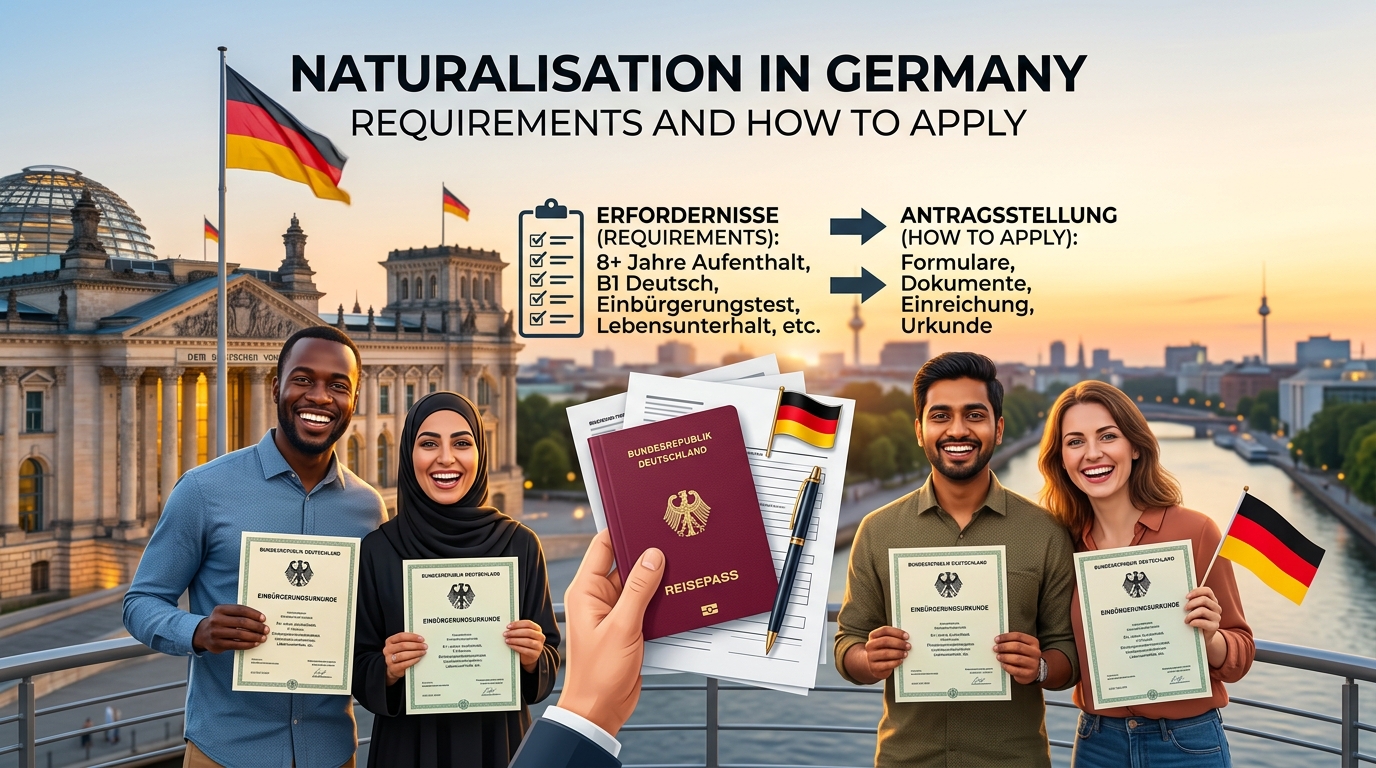
    Naturalisation (Einbürgerung) is the final step on the way to German citizenship. The rules governing it have changed several times in recent years. This article describes the current legal situation (September 2026) under the Nationality Act (Staatsangehörigkeitsgesetz, StAG).

    The nine requirements for entitlement naturalisation (Section 10 StAG)

    1. Lawful habitual residence for five years. Since 27 June 2024, the standard period has been reduced to five years (previously eight). The temporarily available “turbo naturalisation” after just three years for special integration achievements was abolished again on 30 October 2025; since then, a uniform five-year period applies, with no shortcut through that route.
    2. A residence title with a lasting perspective – such as a settlement permit, another permanent title, or one of the statutorily defined residence permits.
    3. A secured livelihood for oneself and dependants, without relying on the Bürgergeld benefit or the new basic income support in force since 1 July 2026 (Book II of the Social Code) or social assistance (Book XII). Exceptions apply, among others, to members of the so-called “guest worker” and contract-worker generation (who entered before 1974 or 1990 respectively), and to people who have worked full-time for at least 20 of the last 24 months, or to their spouse or partner if they live with a minor child as a family unit.
    4. Dual citizenship has generally been permitted since the 2024 reform – the previous requirement to give up one’s existing citizenship no longer applies.
    5. No relevant conviction. Anyone convicted of an unlawful act, or against whom a measure of rehabilitation and prevention has been ordered, is generally excluded; a tolerance threshold of up to 90 daily fine units applies to minor offences (Section 12a StAG). This tolerance threshold does not apply at all, however, to offences motivated by antisemitism, racism or other forms of contempt for humanity – here even a minor conviction leads to exclusion.
    6. Sufficient German language skills at level B1 of the Common European Framework of Reference. For members of the “guest worker” and contract-worker generation, everyday spoken skills are sufficient, and the naturalisation test does not apply to this group.
    7. A passed naturalisation test – 33 questions on Germany’s politics, history, law and society, plus the respective federal state; passed with at least 17 correct answers. Cost: 25 euros per attempt, which may be repeated any number of times.
    8. A declaration of commitment to the free democratic basic order, together with a statement that no efforts against it are or have been pursued or supported (Section 10(1) No. 1 and 1a StAG).
    9. No grounds for exclusion under Section 11 StAG – for example, actual indications of anti-constitutional or extremist activities, or a declaration of commitment that is factually incorrect.

    Costs

    The naturalisation fee is 255 euros per adult and 51 euros per minor child naturalised together with a parent without their own income (Section 38 StAG). Additional costs may include 25 euros for the naturalisation test and, where applicable, fees for language exams and certified translations.

    Spouses and children

    Spouses, registered civil partners and minor children can be naturalised together under Section 10(2) StAG, even if they themselves have not yet completed the five-year period.

    The process

    The application is submitted to the responsible naturalisation authority (usually the city or district administration at the place of residence). Documents typically required include: a valid passport, birth certificate, current residence title, proof of language skills, proof of having passed the naturalisation test, and proof of income. Processing times vary considerably by federal state and municipality – from a few months to more than two years.

    Conclusion

    Naturalisation remains tied to clear, verifiable requirements. Anyone who has not yet reached the five-year mark should use the waiting time to build up language skills, secure their livelihood, and prepare deliberately for the naturalisation test. For specific questions – such as exceptions or how to handle older convictions – individual advice from the naturalisation authority or a migration counselling service is worthwhile.
  • Settlement Permit (Niederlassungserlaubnis): Requirements and How to Apply

    Settlement Permit (Niederlassungserlaubnis): Requirements and How to Apply

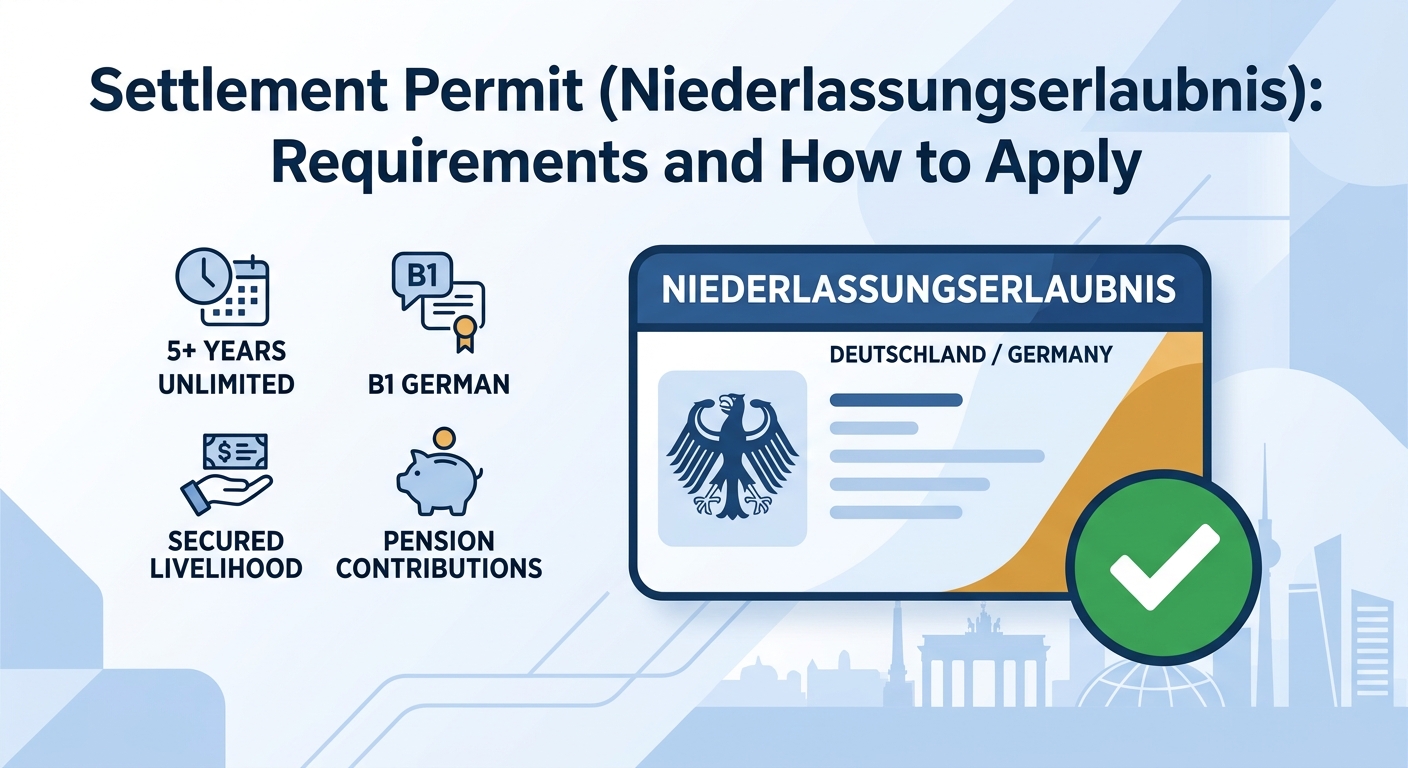
    The settlement permit (Niederlassungserlaubnis) is the permanent residence title of German residence law. It is unlimited in time and place, entitles the holder to pursue any form of employment – including self-employment and changing employers without approval from the Federal Employment Agency – and, unlike the residence permit, does not need to be renewed in substance. Only the card itself, as an electronic residence document, has a maximum usage period of ten years; after that a new card must be issued, but the underlying right of residence is unaffected.

    The standard path: Section 9 AufenthG

    Under Section 9(2) AufenthG, a settlement permit must be granted once the following nine requirements are cumulatively met:

    1. Possession of a residence permit for five years
    2. A secured livelihood
    3. At least 60 months of compulsory or voluntary contributions to the statutory pension insurance (or comparable benefits)
    4. No conflicting grounds of public safety or order
    5. Permitted employment, if the applicant is an employee
    6. Possession of any other permits required for permanent employment
    7. Sufficient German language skills (generally level B1)
    8. Basic knowledge of the legal and social order and living conditions in Germany
    9. Sufficient housing for oneself and family members living in the same household

    Successful completion of an integration course counts as proof of points 7 and 8. Both of these requirements are waived entirely if they cannot be met due to a physical, mental or psychological illness or disability; they may also be waived to avoid undue hardship. For spouses living together in a marital union, it is sufficient if the requirements relating to pension contributions, work permit and other permits are met by just one of the spouses.

    Faster paths for certain groups

    Skilled workers (Section 18c AufenthG): Anyone who has held a residence title under Sections 18a, 18b, 18d or 18g for three years and has paid at least 36 months of pension insurance contributions can obtain the settlement permit after three years instead of five. If the person has completed vocational training or a degree in Germany, the period shortens to two years and 24 months of contributions.

    EU Blue Card holders (Section 18c(2) AufenthG): Here, just 27 months of employment with basic German skills is sufficient, or 21 months with adequate (B1) German skills.

    Recognised refugees and persons entitled to asylum (Section 26(3) AufenthG): The standard path leads to a settlement permit after five years of holding a residence permit, provided the livelihood is predominantly secured and German skills are sufficient (A2). With particularly strong integration – for example, a livelihood that is very largely secured (around 75 percent) and German skills at C1 level – the period shortens to three years. Importantly, the time spent in the preceding asylum procedure counts towards the required period of residence.

    Costs

    The fee for the settlement permit ranges, depending on the legal basis, from roughly 113 to 147 euros; a later reissue of the card after the ten-year usage period expires costs 67 euros.

    What is often overlooked

    • Receiving Bürgergeld, or the new basic income support in force since 1 July 2026, generally stands in the way of a settlement permit – exceptions essentially exist only for illness or disability.
    • Employment gaps due to childcare or home care are credited towards the 60-month pension insurance period.
    • Periods of an earlier stay in Germany, and periods spent abroad of up to six months each, can under certain conditions be credited towards the required period of residence (Section 9(4) AufenthG).

    Conclusion

    The right path to a settlement permit depends heavily on the residence title held so far. Skilled workers and EU Blue Card holders benefit from significantly shorter periods than the general five-year path. An early check with the responsible immigration office helps identify the fastest applicable path and assemble the required evidence – particularly on pension contributions and language skills – in good time.

  • Residence Law in Germany: Titles and Requirements at a Glance

    Residence Law in Germany: Titles and Requirements at a Glance

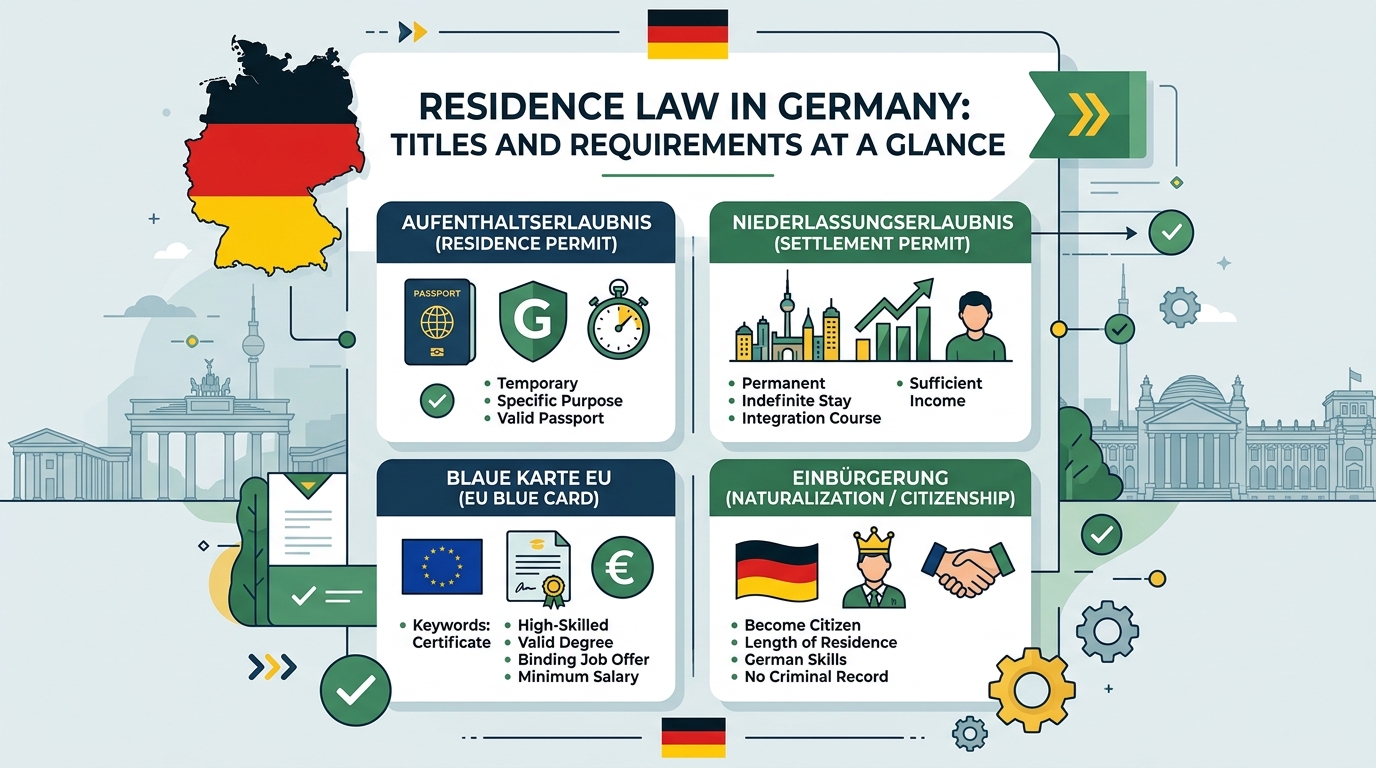
    The German Residence Act (Aufenthaltsgesetz, AufenthG) recognises seven different residence titles. They differ in duration, purpose-binding, and the rights attached to them. This article gives an overview of the most important titles and their requirements (as of September 2026).

    The seven residence titles

    1. Visa (Section 6 AufenthG) – for entry, short-term or national
    2. Residence permit (Aufenthaltserlaubnis) (Section 7 AufenthG) – time-limited and purpose-bound, for work, study, family or humanitarian reasons
    3. EU Blue Card (Section 18g AufenthG) – for academic professionals with a recognised university degree and an employment contract meeting a minimum salary threshold
    4. ICT Card (Section 19 AufenthG) – for intra-company transfers from third countries
    5. Mobile ICT Card (Section 19b AufenthG) – for holders of an ICT Card issued by another EU state
    6. Settlement permit (Niederlassungserlaubnis) (Section 9 AufenthG) – permanent and not tied to a purpose
    7. EU long-term residence permit (Erlaubnis zum Daueraufenthalt-EU) (Section 9a AufenthG) – also permanent, with additional EU-wide mobility

    The residence permit, EU Blue Card, ICT Card, Mobile ICT Card and visa are all time-limited; the settlement permit and EU long-term residence permit are permanent.

    The residence permit: the most common title

    The residence permit is purpose-bound and must be renewed regularly – which is only possible as long as the underlying requirements continue to be met. It is granted, among other things, for:

    • Employment and skilled workers (Sections 18a–19d AufenthG, e.g. for vocational training, academic training or research)
    • The Chancenkarte (Opportunity Card, Section 20a AufenthG) – in force since 1 June 2024, it allows third-country nationals to enter Germany to search for a job based on a points system, even without an existing job offer
    • Self-employment (Section 21 AufenthG)
    • Family reunification (Sections 28–36 AufenthG)
    • Humanitarian, international-law or political reasons, including asylum entitlement and refugee status (Section 25 in conjunction with Section 26 AufenthG)

    The path to the settlement permit

    The settlement permit (Niederlassungserlaubnis) is the strongest form of consolidated residence in German law: permanent, not tied to any location, and entitling the holder to any form of employment. The standard path under Section 9 AufenthG requires, among other things, five years’ possession of a residence permit, a secured livelihood, 60 months of pension insurance contributions, and German language skills at level B1. Faster special paths exist for certain groups – for example for skilled workers under Section 18c AufenthG (generally three years, two years with domestic vocational training or a degree), for holders of the EU Blue Card (21 to 27 months), and for recognised refugees and persons entitled to asylum under Section 26(3) AufenthG (five years as a rule, three years with particularly strong integration). A dedicated article on this website covers the requirements for the settlement permit in detail.

    Important legal changes in 2026

    As of 1 July 2026, the Bürgergeld (citizen’s income) benefit was replaced by the new basic income support for jobseekers (colloquially “Grundsicherungsgeld”). The name in Book II of the Social Code has changed, the duties to cooperate have been made more precise, and the sanction rules have been tightened. For residence-law purposes, what matters remains the same: receiving benefits under Book II or Book XII of the Social Code generally stands in the way of being granted a settlement permit, unless a statutory exception applies (for example due to illness or disability).

    On 12 June 2026, the European CEAS reform also came into force, affecting primarily the asylum procedure – with consequences for border procedures and reception conditions, as described in more detail in the article on rights and duties.

    How do I know which path applies to me?

    Which residence title and which path to permanent settlement applies in an individual case depends on the previous purpose of stay, the length of stay, and personal factors such as language skills and employment situation. An individual assessment by the responsible immigration office or a qualified counselling service is always advisable, since the legal situation – as the 2026 examples show – continues to change.