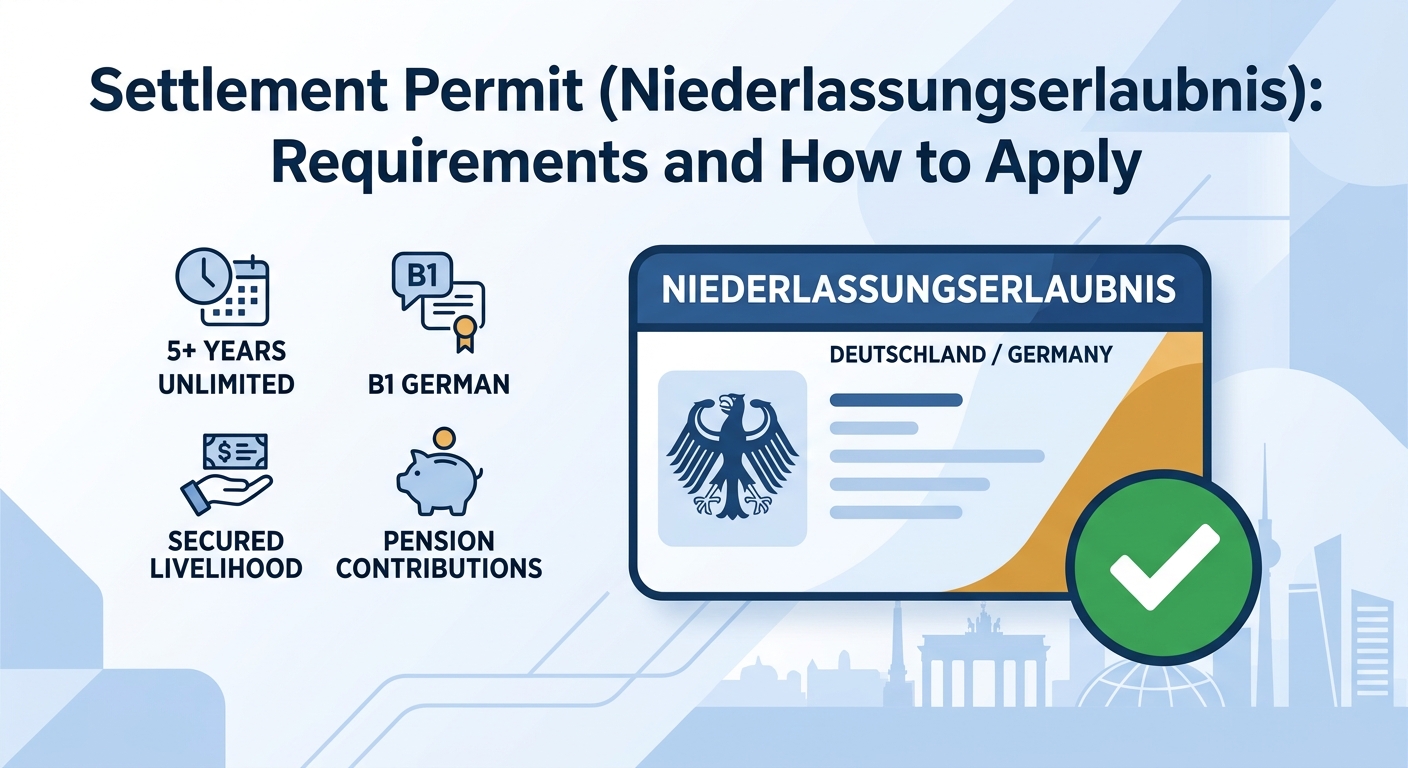
The settlement permit (Niederlassungserlaubnis) is the permanent residence title of German residence law. It is unlimited in time and place, entitles the holder to pursue any form of employment – including self-employment and changing employers without approval from the Federal Employment Agency – and, unlike the residence permit, does not need to be renewed in substance. Only the card itself, as an electronic residence document, has a maximum usage period of ten years; after that a new card must be issued, but the underlying right of residence is unaffected.
See more like this
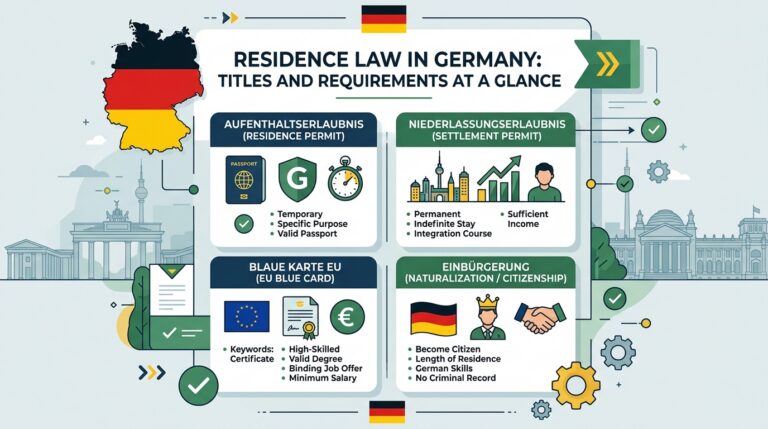

The standard path: Section 9 AufenthG
Under Section 9(2) AufenthG, a settlement permit must be granted once the following nine requirements are cumulatively met:
See more like this
- Possession of a residence permit for five years
- A secured livelihood
- At least 60 months of compulsory or voluntary contributions to the statutory pension insurance (or comparable benefits)
- No conflicting grounds of public safety or order
- Permitted employment, if the applicant is an employee
- Possession of any other permits required for permanent employment
- Sufficient German language skills (generally level B1)
- Basic knowledge of the legal and social order and living conditions in Germany
- Sufficient housing for oneself and family members living in the same household
Successful completion of an integration course counts as proof of points 7 and 8. Both of these requirements are waived entirely if they cannot be met due to a physical, mental or psychological illness or disability; they may also be waived to avoid undue hardship. For spouses living together in a marital union, it is sufficient if the requirements relating to pension contributions, work permit and other permits are met by just one of the spouses.
Faster paths for certain groups
Skilled workers (Section 18c AufenthG): Anyone who has held a residence title under Sections 18a, 18b, 18d or 18g for three years and has paid at least 36 months of pension insurance contributions can obtain the settlement permit after three years instead of five. If the person has completed vocational training or a degree in Germany, the period shortens to two years and 24 months of contributions.
See more like this
EU Blue Card holders (Section 18c(2) AufenthG): Here, just 27 months of employment with basic German skills is sufficient, or 21 months with adequate (B1) German skills.
Recognised refugees and persons entitled to asylum (Section 26(3) AufenthG): The standard path leads to a settlement permit after five years of holding a residence permit, provided the livelihood is predominantly secured and German skills are sufficient (A2). With particularly strong integration – for example, a livelihood that is very largely secured (around 75 percent) and German skills at C1 level – the period shortens to three years. Importantly, the time spent in the preceding asylum procedure counts towards the required period of residence.
Costs
The fee for the settlement permit ranges, depending on the legal basis, from roughly 113 to 147 euros; a later reissue of the card after the ten-year usage period expires costs 67 euros.
What is often overlooked
- Receiving Bürgergeld, or the new basic income support in force since 1 July 2026, generally stands in the way of a settlement permit – exceptions essentially exist only for illness or disability.
- Employment gaps due to childcare or home care are credited towards the 60-month pension insurance period.
- Periods of an earlier stay in Germany, and periods spent abroad of up to six months each, can under certain conditions be credited towards the required period of residence (Section 9(4) AufenthG).
Conclusion
The right path to a settlement permit depends heavily on the residence title held so far. Skilled workers and EU Blue Card holders benefit from significantly shorter periods than the general five-year path. An early check with the responsible immigration office helps identify the fastest applicable path and assemble the required evidence – particularly on pension contributions and language skills – in good time.
See more like this