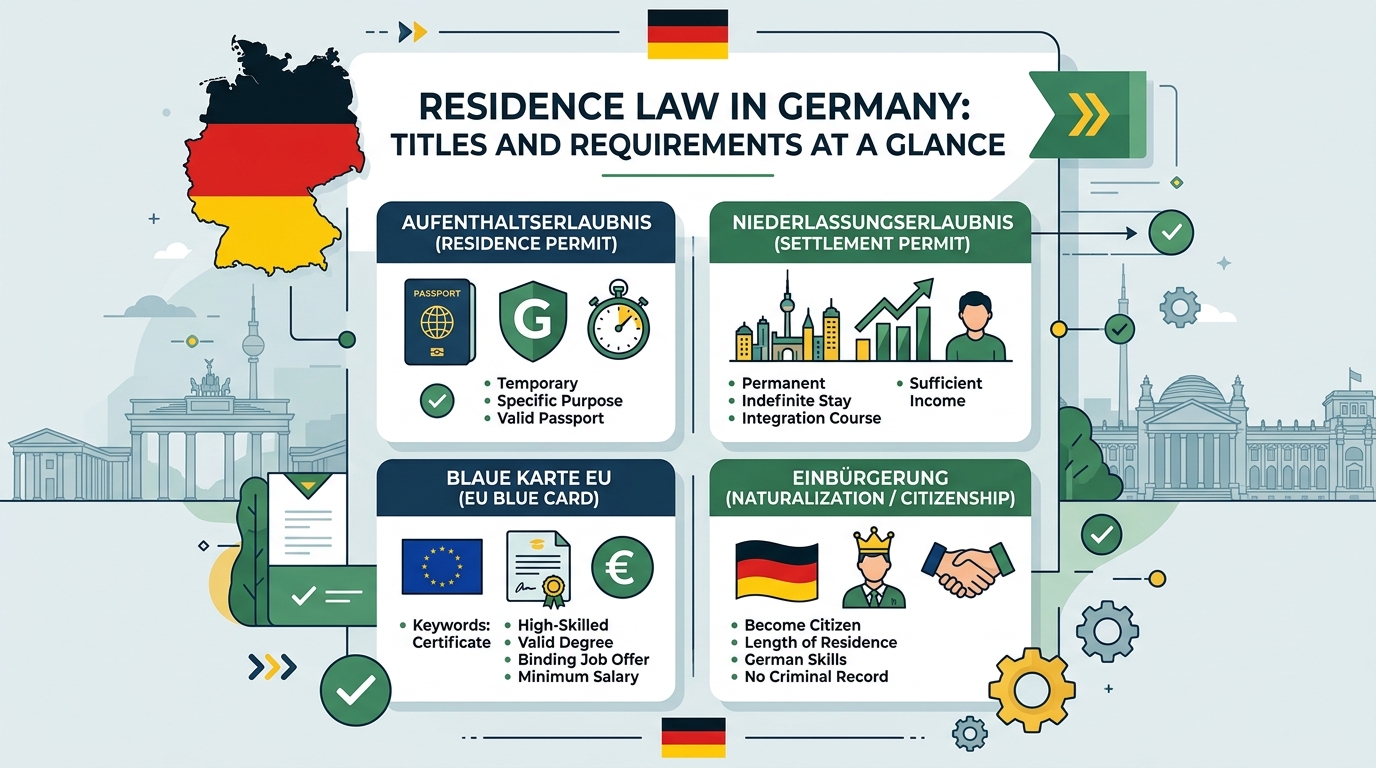
The German Residence Act (Aufenthaltsgesetz, AufenthG) recognises seven different residence titles. They differ in duration, purpose-binding, and the rights attached to them. This article gives an overview of the most important titles and their requirements (as of September 2026).
See more like this
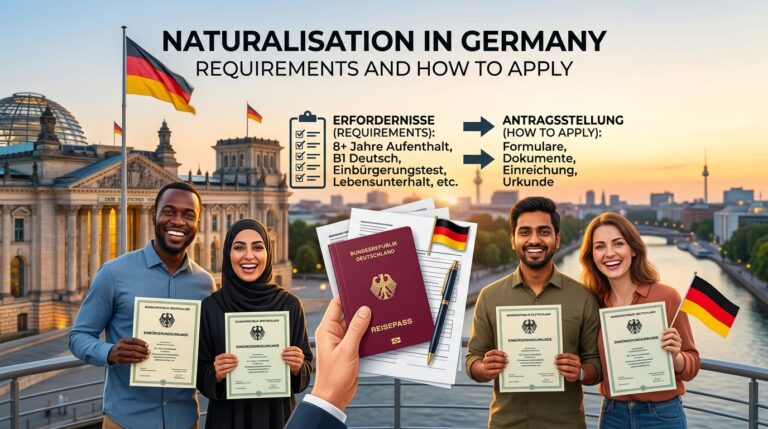



The seven residence titles
- Visa (Section 6 AufenthG) – for entry, short-term or national
- Residence permit (Aufenthaltserlaubnis) (Section 7 AufenthG) – time-limited and purpose-bound, for work, study, family or humanitarian reasons
- EU Blue Card (Section 18g AufenthG) – for academic professionals with a recognised university degree and an employment contract meeting a minimum salary threshold
- ICT Card (Section 19 AufenthG) – for intra-company transfers from third countries
- Mobile ICT Card (Section 19b AufenthG) – for holders of an ICT Card issued by another EU state
- Settlement permit (Niederlassungserlaubnis) (Section 9 AufenthG) – permanent and not tied to a purpose
- EU long-term residence permit (Erlaubnis zum Daueraufenthalt-EU) (Section 9a AufenthG) – also permanent, with additional EU-wide mobility
The residence permit, EU Blue Card, ICT Card, Mobile ICT Card and visa are all time-limited; the settlement permit and EU long-term residence permit are permanent.
See more like this
The residence permit: the most common title
The residence permit is purpose-bound and must be renewed regularly – which is only possible as long as the underlying requirements continue to be met. It is granted, among other things, for:
- Employment and skilled workers (Sections 18a–19d AufenthG, e.g. for vocational training, academic training or research)
- The Chancenkarte (Opportunity Card, Section 20a AufenthG) – in force since 1 June 2024, it allows third-country nationals to enter Germany to search for a job based on a points system, even without an existing job offer
- Self-employment (Section 21 AufenthG)
- Family reunification (Sections 28–36 AufenthG)
- Humanitarian, international-law or political reasons, including asylum entitlement and refugee status (Section 25 in conjunction with Section 26 AufenthG)
The path to the settlement permit
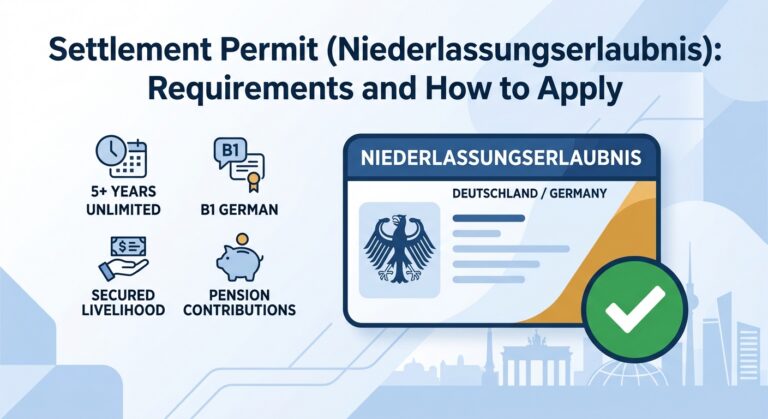
The settlement permit (Niederlassungserlaubnis) is the strongest form of consolidated residence in German law: permanent, not tied to any location, and entitling the holder to any form of employment. The standard path under Section 9 AufenthG requires, among other things, five years’ possession of a residence permit, a secured livelihood, 60 months of pension insurance contributions, and German language skills at level B1. Faster special paths exist for certain groups – for example for skilled workers under Section 18c AufenthG (generally three years, two years with domestic vocational training or a degree), for holders of the EU Blue Card (21 to 27 months), and for recognised refugees and persons entitled to asylum under Section 26(3) AufenthG (five years as a rule, three years with particularly strong integration). A dedicated article on this website covers the requirements for the settlement permit in detail.
See more like this
Important legal changes in 2026
As of 1 July 2026, the Bürgergeld (citizen’s income) benefit was replaced by the new basic income support for jobseekers (colloquially “Grundsicherungsgeld”). The name in Book II of the Social Code has changed, the duties to cooperate have been made more precise, and the sanction rules have been tightened. For residence-law purposes, what matters remains the same: receiving benefits under Book II or Book XII of the Social Code generally stands in the way of being granted a settlement permit, unless a statutory exception applies (for example due to illness or disability).
On 12 June 2026, the European CEAS reform also came into force, affecting primarily the asylum procedure – with consequences for border procedures and reception conditions, as described in more detail in the article on rights and duties.
How do I know which path applies to me?
Which residence title and which path to permanent settlement applies in an individual case depends on the previous purpose of stay, the length of stay, and personal factors such as language skills and employment situation. An individual assessment by the responsible immigration office or a qualified counselling service is always advisable, since the legal situation – as the 2026 examples show – continues to change.