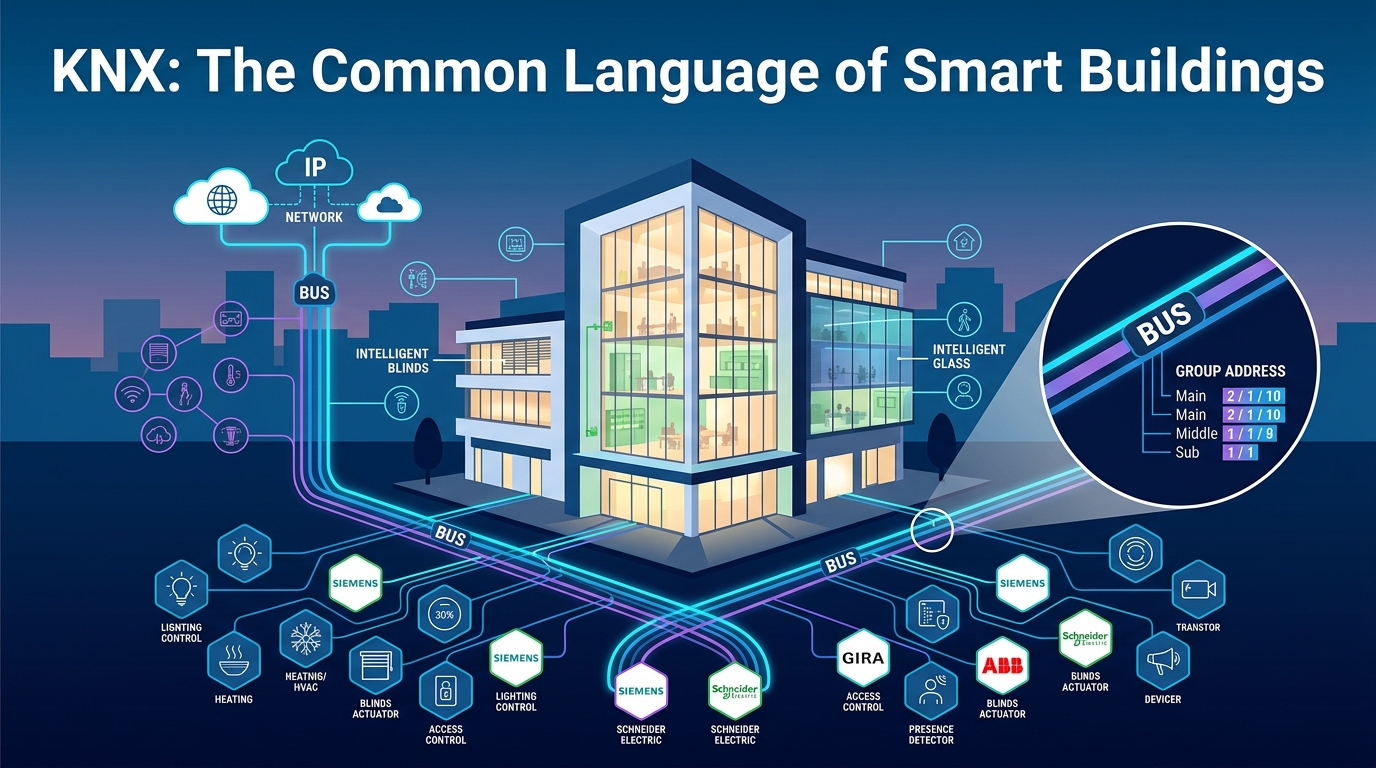
Walk into a modern office, school, or well-renovated home in Europe, and there’s a good chance its lighting, blinds, heating, and access control are all speaking the same language: KNX. Unlike proprietary “smart home” ecosystems tied to a single manufacturer, KNX is an open, international standard (ISO/IEC 14543-3) supported by hundreds of manufacturers — which means a light switch from one company can control a dimmer from another, decades apart, without any cloud service in between.
See more like this


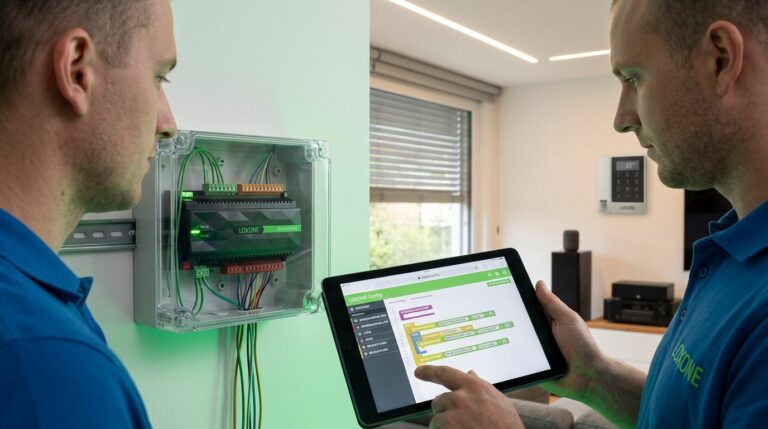

At the heart of KNX is the bus: a two-wire cable (or, increasingly, IP/Wi-Fi) that carries small data telegrams between devices. A push-button doesn’t switch a light directly — it sends a telegram onto the bus with a group address, and any device configured to listen on that address reacts: a relay switches a light, a dimming actuator adjusts brightness, a display shows a status. This decoupling is what makes KNX systems so flexible: changing what a button does is a configuration change, not a rewiring job.
See more like this
Design and commissioning happen in ETS (Engineering Tool Software), where the electrical planner defines group addresses, assigns devices, and programs logic — from simple “one button, one light” pairings to complex scenes, presence-based HVAC control, and shading that responds to sun position and wind speed. A well-structured group address scheme (main group / middle group / sub-group) is what separates a maintainable installation from a tangled mess that only its original installer can understand.
KNX shines especially in retrofit and long-lifecycle buildings — schools, public administration, hospitals — where the wiring topology needs to outlast any single vendor’s product roadmap. It also integrates cleanly with building-wide automation, weather stations, and increasingly with visualization systems and voice assistants via IP gateways. For an electrical planner, fluency in KNX isn’t just about knowing which actuator to specify — it’s about designing a group address structure and cabling topology today that a completely different team can still expand ten years from now.
See more like this