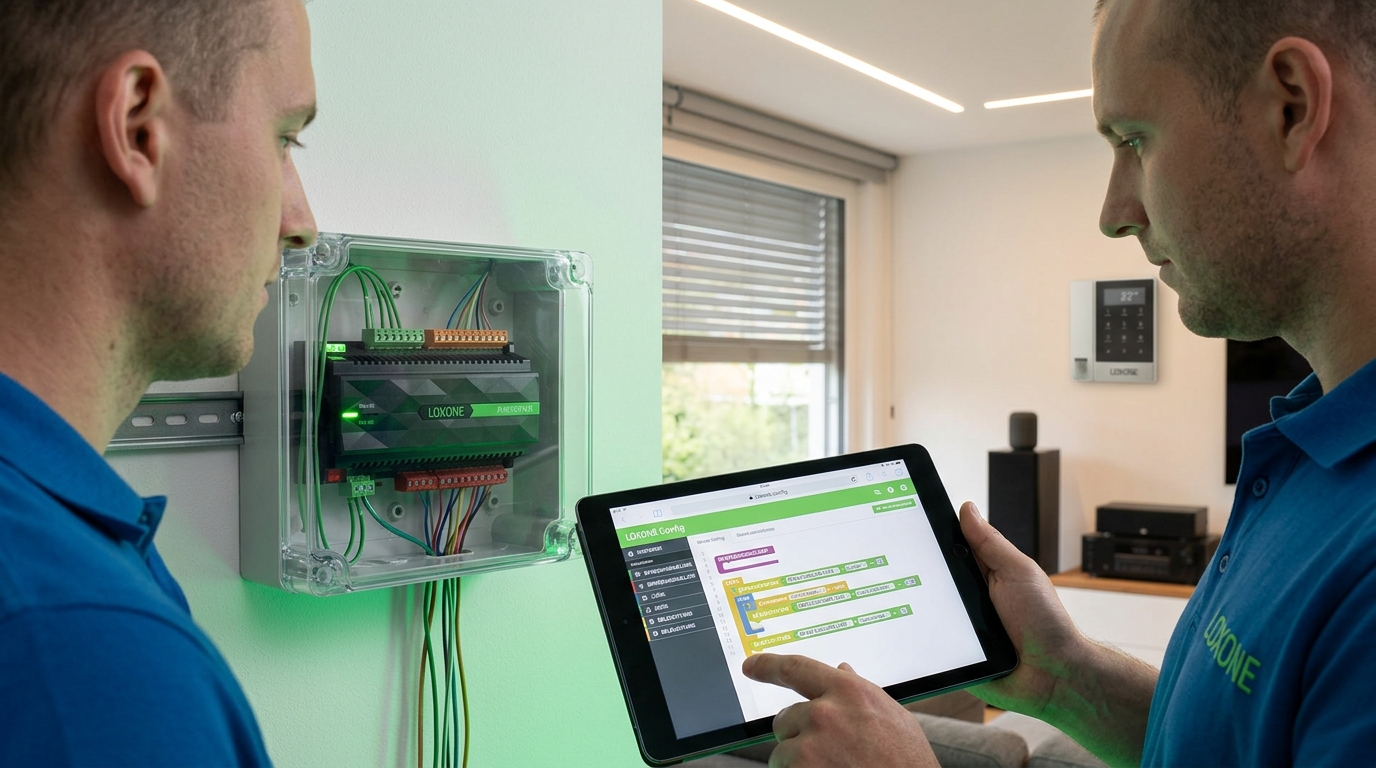
If KNX is the open, decentralized standard of building automation, Loxone represents the opposite design philosophy: a single, centralized “Miniserver” that acts as the brain of the entire building, with proprietary software (Loxone Config) tying lighting, heating, shading, audio, irrigation, and security into one coherent system. That trade-off — less openness, more integration out of the box — has made Loxone especially popular with system integrators and private homeowners who want powerful automation without assembling it from a dozen different manufacturers’ components.
See more like this



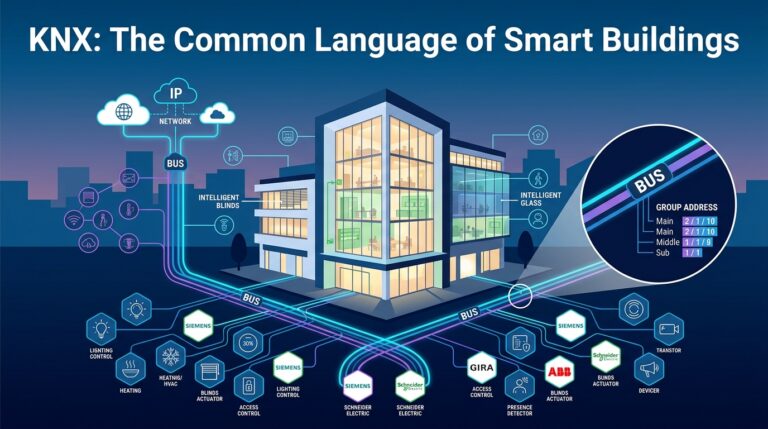



The Miniserver connects to sensors and actuators over Loxone’s own Tree bus (a simple two-wire topology that’s fast to install) or via extensions for KNX, DMX, Modbus, and other protocols — meaning a Loxone installation can absorb an existing KNX system rather than replacing it. Programming happens visually in Loxone Config, where function blocks are wired together on a canvas: a motion sensor block feeds into a logic block, which feeds into a lighting output — no textual programming required for most standard tasks, though a scripting interface exists for advanced logic.
See more like this
Where Loxone particularly stands out is its native intelligence for comfort and energy: it can shift shading automatically based on sun position, outdoor temperature, and indoor CO₂ levels; learn a household’s presence patterns; and manage heating zones with weather-compensated curves — all coordinated from one place rather than stitched together across separate subsystems. Its app-based visualization is also famously polished, letting homeowners control and monitor everything from a phone without a separate visualization project.
The trade-off engineers should weigh: Loxone’s ecosystem lock-in means you’re relying on one manufacturer’s roadmap, and its Tree/Air wiring isn’t interchangeable with other brands’ hardware the way KNX devices are. But for renovation projects and new builds where a single integrator will own the whole system, Loxone often delivers a more polished result, faster, than assembling an equivalent KNX installation from scratch.
See more like this