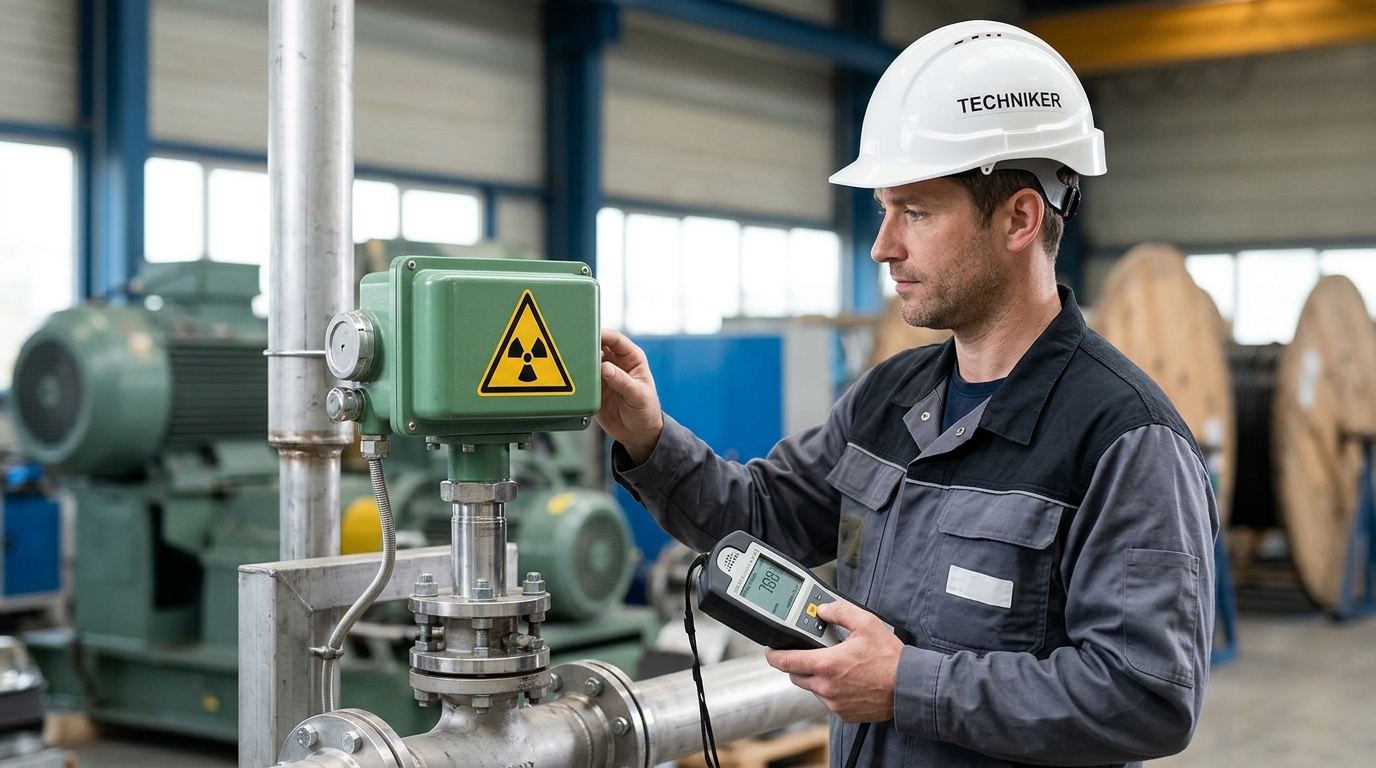
When people hear “radiation protection,” they usually think of nuclear power plants or hospital X-ray departments. In reality, ionizing and non-ionizing radiation shows up in far more everyday technical work than most people realize: X-ray inspection of welds and pipework, industrial radiography, medical imaging equipment, certain measurement and level-gauging devices, and increasingly, high-power radio and microwave installations. Anyone who plans, installs, maintains, or works near this equipment needs a working understanding of Strahlenschutz — radiation protection — even if their main job title is “electrician” or “technician,” not “radiation physicist.”
See more like this

The foundation of radiation protection rests on three simple principles: time, distance, and shielding. Minimizing the time spent near a radiation source, maximizing distance (since exposure typically falls off with the square of distance), and using appropriate shielding material (lead, concrete, water, depending on radiation type) together reduce dose to a fraction of what unprotected exposure would deliver. On top of this physical foundation sits a legal and administrative framework — in Germany, primarily the Strahlenschutzgesetz (StrlSchG) and Strahlenschutzverordnung (StrlSchV) — which defines dose limits, monitoring obligations, training requirements, and the roles of a Strahlenschutzbeauftragter (radiation protection officer) and Strahlenschutzverantwortlicher (radiation protection supervisor).
See more like this
Training programs — organized into Fachkundegruppen such as S4 (industrial radiography) and S5 (measuring devices, gauging, and similar low-risk applications) — are structured around exactly this combination: enough physics to understand what’s actually dangerous and why, enough legal knowledge to operate compliantly, and enough practical judgment (dosimetry, source handling, emergency procedures) to keep both yourself and others safe. A Grundmodul (basic module) covers the shared fundamentals, while a Fachkundemodul (specialist module) tailors the training to the specific device category or application.
For anyone working at the intersection of measurement technology, building automation, or industrial instrumentation, radiation protection knowledge isn’t a specialist detour — it’s part of the baseline competence needed to work safely and legally around equipment that, on the surface, looks like just another sensor on a schematic.
See more like this